Valuer Insights
Business Insights | The Sandy Ridge tender accelerates the AI-driven transformation of Hong Kong’s data centre landscape
By Valuation and Advisory Services
December 5, 2025

Contact

Emerging AI Deployment in Hong Kong
Hong Kong’s private sector is adopting artificial intelligence (AI) not just as a tool for automation, but as a strategic enabler of innovation and competitiveness. According to the Enterprise AI Transformation Survey Report 20251, over 56% of Hong Kong enterprises have begun deploying AI technologies, with generative AI and large language models (LLMs) being the mainstream applications.With the accelerated adoption of AI and cloud-native technologies, Hong Kong’s data centre market is undergoing a fundamental shift in infrastructure demand. AI applications—particularly those involving large language models (LLMs), GenAI, and real-time inference—are reshaping the design of data centres. Key infrastructure adaptations include:
- High-density GPU rack solutions with 40kW or above, vs traditional setups of 5–15kW.
- Low-latency networks for real-time AI inference.
- Advanced Cooling Technologies like liquid cooling, immersion cooling, direct-to-chip.
Legacy data centre designs are increasingly inadequate for AI-centric operations. The shift toward AI-ready infrastructure is prompting developers to rethink their design philosophies—from stacking hardware to building intelligent, software-defined architectures.
Some 200MW of new developments in Hong Kong are featuring high-density racks, advanced cooling systems, and ultra-low latency network architecture. These developments reflect a paradigm shift in Hong Kong’s data centre strategy—from traditional colocation models to AI-optimized hyperscale infrastructure.
The Sandy Ridge site tender is part of a long-term plan
Currently, Hong Kong’s established data centre clusters in Tseung Kwan O, Tsuen Wan, and Kwai Chung may still offer limited greenfield or brownfield sites for development. However, constraints in land size, power supply, and project scalability are likely to pose increasing challenges in accommodating next-generation infrastructure.In contrast, the Northern Metropolis, with its extensive newly planned land resources, presents a compelling opportunity. The availability of large-scale land plots offers the potential to support the development of high-capacity, future-proof data centre ecosystems. A key initiative is the Sandy Ridge site, that has now been made available by the Hong Kong government for tender. Some of the key information is highlighted below:
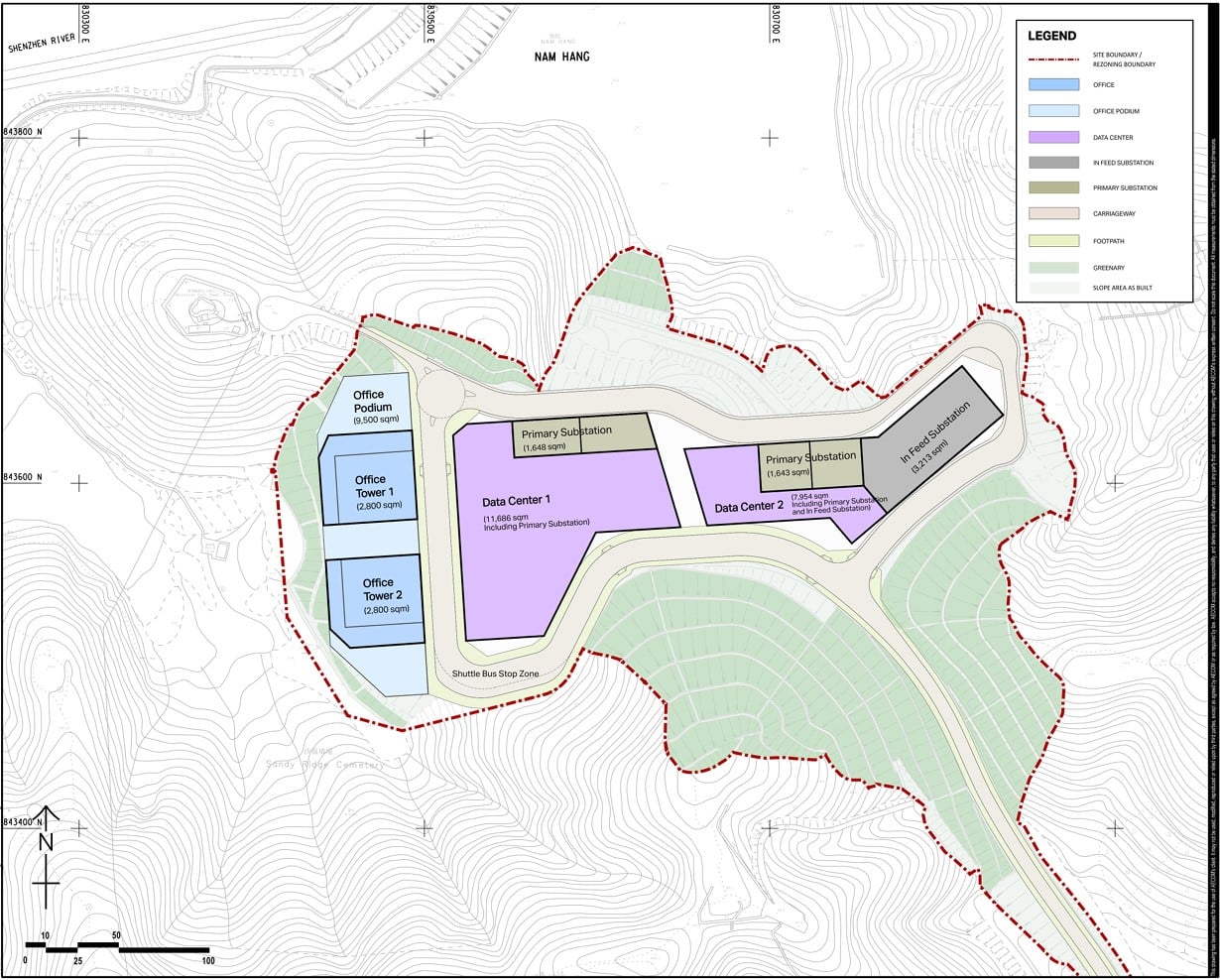
- The Site: Lot No. 953 in Demarcation District No. 89 at Sandy Ridge, North District (Sandy Ridge Data Facility Cluster site). Situated in the Northern Metropolis adjacent to Lo Wu.
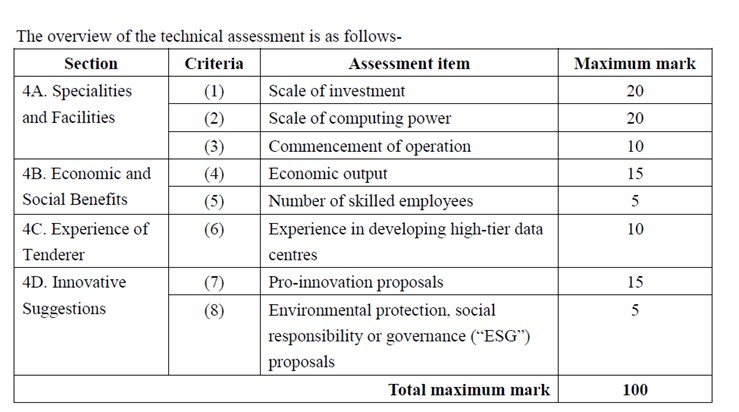
- Two envelope approach (70% technical and 30% price weighting).
- Site area of 116,365 sqm (1.25m sq. ft.).
- Maximum GFA of 250,000 sqm (2.7m sq. ft.) with at least 70% for high-tier data centre use.
- Aim: growth of data and artificial intelligence-related industries, HK as regional digital infrastructure hub.
- Rezoning from “Other Specified Uses” annotated “Cemetery, Columbarium, Crematorium and Funeral Related Uses” to “OU” annotated “Innovation and Technology” for Data and Computing Facility Cluster uses.
- Building covenant: 72 calendar months.
- Tender closing 31 December 2025.
CBRE’s View:
- According to the tender notice, an RFI process run between March and April 2025 received positive responses from the market. However, there are challenges including the remote location of the site, a lack of ancillary facilities and existing infrastructure, and the sloped, irregular site layout.
- Also, while the building must be completed within six years, water supply is not guaranteed by the Government. The tender mentions that freshwater supply ‘may’ be provided but also notes that there may be a delay in that supply. However, the purchaser must construct appropriate infrastructure including plumbing and outstations for water metering. With regards to power, a separate application must be filed to CLP, and the purchaser will have to construct a dedicated substation for electricity connection. Therefore, the purchaser will have to bear significant cost on utility installations without full certainty on the provision and timing of sufficient utilities to run a large-scale data centre campus.
- The number of potential bidders will be limited given the sheer size of the land plot. We expect the IT Load of the campus to be well over 200MW if fully built out. Only Sunevision’s MEGA IDC development in TKO (180MW) comes close. Currently there is just over 600MW existing capacity in Hong Kong, increasing to 1GW once current developments are complete. The Sandy Ridge site represents about 1/3 of the existing capacity and about 20% of the future capacity of Hong Kong. With current vacancies in urban data centres, leasing to customers could prove challenging at this moment given ample availability. However, given the mid-to-long-term nature of this project, market conditions might change near completion given increasing demand from AI operations.
- With the assessment items in the tender marking scheme, the site is expected to be developed into an AI data centre campus which further limits the number of potential bidders. Bidders might be deep-pocketed Chinese hyperscalers like Alibaba, Tencent, Huawei or ByteDance. Fittingly, Alibaba has recently purchased a large portion of the new One Causeway Bay office for their headquarters. Joint ventures between experienced data centre operators as well as more traditional developers might also be possible. Large sites available for owner operation are scarce in Hong Kong so this site could be attractive to meet this demand.
- Putting the focus on technical rather than monetary aspects is the right approach as Hong Kong is competing with other data centre hubs in the region, especially in South(-East) Asia (Johor Bahru, Batam Island, Mumbai) where large campuses are being built by major hyperscalers for AI deployment at lower cost. The Singaporean government has also recently announced an ambitious plan to turn parts of Jurong Island into a 700MW data centre park. Given otherwise scarce availability of developable land, the Singaporean programme is expected to draw widespread interest from major players.
- Being further away from the urban centre would be acceptable for AI training which does not require extremely low latency. However, given the substantial investment volume, it is still questionable whether the site would be able to be competitive on a regional level in this regard. For inference AI, the distance to urban areas and therefore the latency might be too high, unless there is more of an integration with the general northern metropolis plans. In any case, bids for the land are expected to be in the triple-digit HK$ per sq. ft. of GFA, considering the substantial construction and fit-out cost, site location, and current market conditions.
- The service deed which must be signed by the purchaser of the Sandy Ridge site with the Hong Kong government will remain in place for the duration of the land lease (50 years). During this time, the government will monitor the operation of the data centre. Certain provisions allow the government to terminate the agreement. This might play a role in delibrations of data centre operators to bid for the site.
Conclusion:
The Sandy Ridge site tender represents a rare and strategic opportunity for Hong Kong’s data centre market. As AI and HPC workloads accelerate, operators will require high-density racks (50–100kW) and advanced cooling solutions, making large-scale development increasingly critical. While Hong Kong remains constrained by land, securing a site with substantial power capacity offers a significant competitive edge. Despite the challenges posed by the size of Sandy Ridge, its scale positions it as one of the few locations capable of supporting next-generation infrastructure demand. The site could prove attractive for Mainland Chinese players aiming to get a foothold in Hong Kong. Any bids on the site are also a bet on the future of AI and Hong Kong’s status as data traffic hub in the region.We welcome the government's two-envelope approach, recognising its importance ensuring both technical competence and financial soundness for this strategically vital project. Given signs of AI emergence in the city, it is important for the government to make appropriate plans for the data centre land supply pipeline. Due to the large-scale development and its remote location, only selective operators who have the capacity to own the property will join the bid.
On the other hand, the government needs to ensure that there is sufficient infrastructure nearby to operate the data centre and enable employees of this data centre campus to easily access the site. Furthermore, there should be solid plans for other potential data centre sites as currently over 100 million sq. ft. of I&T related GFA is planned in the Northern Metropolis which could be utilized for data centre development. A healthy mix of different innovative industries will be key to avoid oversupply of a single sector.
How CBRE Can Support Your Data Centre Strategy
With rising demand from cloud operations and AI, data centres are at the fore of innovation in the real estate sector.CBRE support clients throughout the entire lifecycle and in all aspects of a data centre project. From initial feasibility assessments, deal and financial analysis, valuations of shell and core, operational- and under development data centres, our Valuation and Advisory team works closely with our integrated data centre services lines to offer best in class advice that is supported by data.
1 Enterprise AI Transformation Survey Report 2025, Votee, June 2025