Valuer Insights
Business Insights | Strategic Approach for Investors: Hostels in the City Scheme
September 25, 2025

Contact

Contact
Director, Valuation & Advisory Services, Hong Kong

Contact
Senior Manager, Valuation and Advisory Services, Hong Kong

This article evaluates the benefits of the scheme from an investor’s perspective and discusses strategic approaches to tenant acquisition and operational management under the scheme.
The True Value of the Scheme: Why It Matters for Investors
Before the launch of the Scheme, student accommodation in Hong Kong was typically delivered through two main channels: leasing out residential flats or operating under a hotel or guesthouse licence. The Scheme introduces a third pathway into the student housing market, offering a more structured framework and potentially greater value for investors compared to traditional models.- Repurposing Commercial Space: A Viable Alternative to Hotel Licensing
Under the traditional hotel licensing framework, operating a student hostel typically requires acquiring an existing hotel property, as converting a commercial building into a hotel is often difficult due to strict requirements, such as designated pick-up/drop-off areas, parking and loading/unloading facilities, and extensive back-of-house infrastructure.
In contrast, the Scheme enables investors to convert commercial assets into student hostels without needing to meet these hotel-specific standards. This not only expands the pool of viable investment assets but also allows owners of existing commercial buildings to tap into the student accommodation market.
Certain facilities within existing commercial buildings, such as excessive car parking provision, can be converted into supporting amenities for student hostels, such as gyms or study areas. Subject to approval by the Buildings Department, these converted spaces may continue to qualify for Gross Floor Area (GFA) exemption, offering further incentives for investors.
- Partial Conversions: New Potential for Mixed-Use Assets
The Scheme is particularly attractive for owners of mixed-use or underperforming assets. For example, a landlord may convert a vacant retail podium within a mixed-use development into student accommodation while continuing to operate the upper floors as other uses like hotel or office 1.
The Scheme permits partial conversions, which opens new possibilities for adaptive reuse, allowing investors to unlock value from underutilised components of their portfolios without committing to full-scale redevelopment.
- Policy-Backed Access to Previously Inaccessible Sites
The Scheme also allows for non-provision of open space and service lane under regulations 25 and 28 of the Building (Planning) Regulations through exemptions made by virtue of section 42(1) of the Buildings Ordinance (BO). This enables certain commercial buildings on Class A sites to effortlessly tap into the booming market—an opportunity that was previously unattainable before the introduction of this scheme.
- Accelerated Timelines Through Regulatory Streamlining
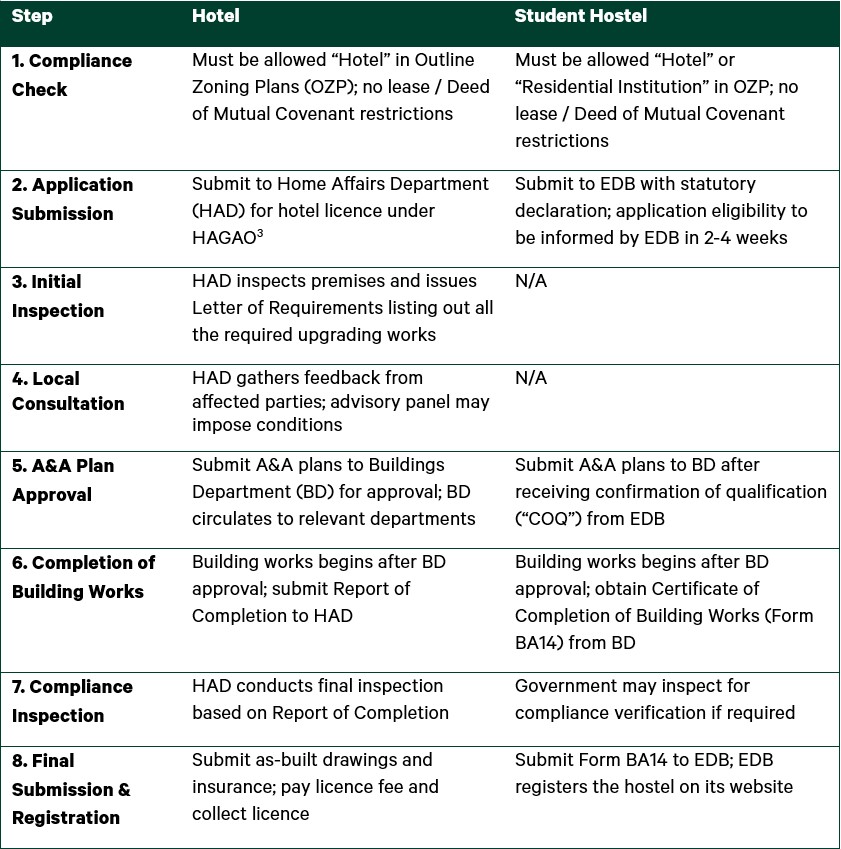
Traditionally, student hostels could be operated under a hotel licence, a process that may face extended timelines due to complex requirements set out in the Hotel and Guesthouse Accommodation Ordinance. These projects also require local consultations and multiple inspections. In contrast, student hostel conversions under the Scheme benefit from streamlined approvals 2.
Additionally, while hotel operations are subject to ongoing license renewal requirements, hostel conversions under the Scheme are exempt from such obligations, further reducing long-term operational complexity and administrative overheads for investors and operators. Instead, the student hostel operators are required to submit an annual report to Education Bureau (EBD) covering statistics on the occupation, profile of tenants, etc.
Application Procedures: Hotel Licence vs. Hostels in the City Scheme
Unlocking Opportunity: Value-Added Operational Strategies
The Scheme offers a unique platform for investors to enter the student housing market with agility and opens the potential of underutilised commercial properties. Alongside the Scheme, the following strategies illustrate how investors can further enhance stability, visibility, and tenant acquisition through targeted partnerships, market positioning and operational strategies.
Partnering with Universities: Building Trust and Stability
By forming direct partnerships with institutions, investors can secure consistent occupancy and align hostel offerings with academic calendars and student needs. These collaborations may include:
- Bulk leasing agreements for exchange programs or postgraduate cohorts.
- Exclusive arrangements with designated universities aim to enhance security and foster a sense of community.
Engaging Private University Counselling Companies
- Referral partnerships with commission-based incentives.
- Co-branded service bundles that include accommodation, visa support, and orientation.
- Regional targeting through localised agents in Southeast Asia, Mainland China, and beyond.
Optimising Hostel Operations
Well-designed operational policies are essential to the success of student hostels. Beyond physical infrastructure, thoughtful management practices help foster a safe, supportive, and student-friendly environment. These approaches not only enhance the residential experience but also contribute to long-term reputation and operational continuity:
Safety Through Curfew and Visitor Limits
Implementing a curfew and limiting visitor access after midnight can enhance the safety and well-being of student residents. These measures help maintain a secure and quiet living environment, reduce the risk of unauthorized access, and align with the expectations of both parents and educational institutions.
Single-Gender Dormitory Options
Offering single-gender dormitory options can cater to cultural preferences and may enhance comfort and privacy for residents. It also allows hostel operators to tailor amenities and programming to the specific needs of each group, improving overall resident satisfaction.
Vertical Integration with Educational Institutions
Introducing educational institutions on the lower floors of a mixed-use building, while converting upper floors into student hostels, creates a vertically integrated ecosystem. This model fosters convenience, collaboration, and community among students and educators. It also enhances the building’s utility and marketability, offering a one-stop solution for academic engagement and residential needs.
How CBRE Can Support Your Student Housing Strategy
With rising student populations and limited on-campus accommodation, the Hostels in the City Scheme presents a timely opportunity for institutions and investors to address this growing need supported by long-term policy incentives.
CBRE support clients throughout the entire lifecycle of a student hostel project under the Scheme. From initial feasibility assessments for submission to EDB, obtaining A&A plan approvals from BD, advising the impact on property value and financial feasibility assessment, our integrated technical services (including building survey, quantity survey and project management teams) and Valuation and Advisory team ensures that your project is not only viable — but also future-ready.
Contact us today to explore how we can help you capitalize on this opportunity.
1 For retail podiums in residential zoning, partial conversion to student hostel under the ‘hotel’ use is subject to planning approval by the Town Planning Board, as well as the DMC conditions
2 A new Development Projects Facilitation Office under the Development Bureau has been established to coordinate cross-departmental approvals. This “one-stop shop” approach enhances administrative efficiency and provides greater certainty for developers and institutions.
3 Hotel and Guesthouse Accommodation Ordinance (Cap. 349)