Valuer Insights
Business Insights | Hong Kong's Residential Market: A Resilient Rebound Driven by Renewed Confidence
December 4, 2025

Contact
Angus Luk
Senior Director, Valuation & Advisory Services, Hong Kong

Amidst signs of economic stabilization, including potential interest rate adjustments and easing geopolitical tensions, Hong Kong's residential property market is experiencing a significant resurgence. This recovery is fuelled by a confluence of factors, notably a concentrated release of pent-up demand, leading to a notable "revenge buying" phenomenon. The market's dynamism is evident in the robust performance of both primary and secondary transaction volumes, coupled with a discernible upward trend in property prices.
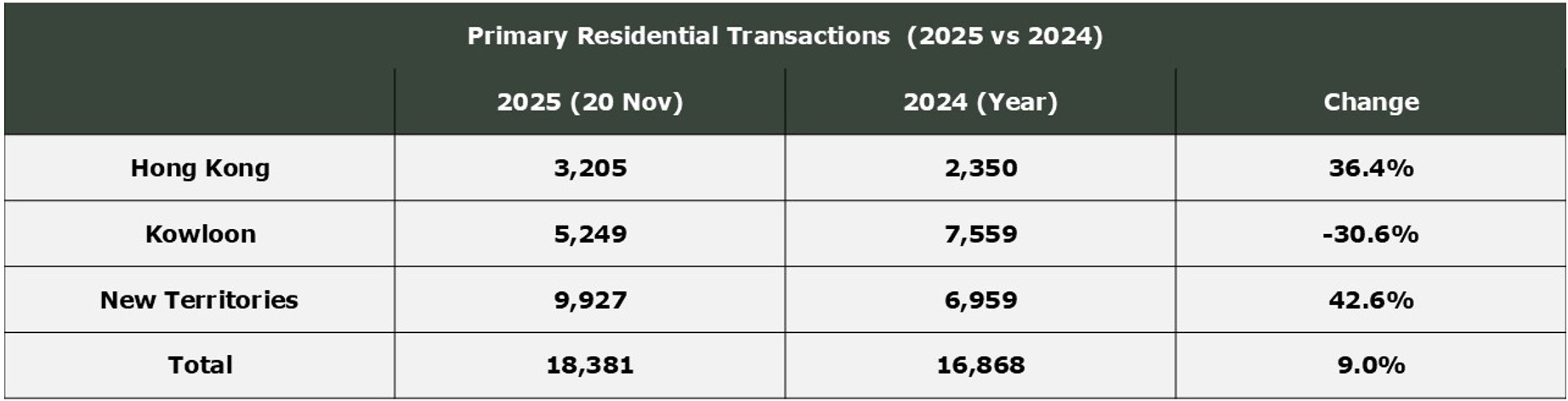
The primary market showcases remarkable strength. As of November 20, 2025, the market has seen transaction volume of 18,381 units, representing a substantial 9% increase compared to the entirety of the previous year's 16,868 transactions. This demonstrates a surge in consumer confidence and buying activity. The New Territories and Hong Kong Island have seen particularly strong growth, with 9,927 transactions in the New Territories, a 42.6% increase compared to last year's figures, and 3,205 transactions on Hong Kong Island, a 36.4% increase.
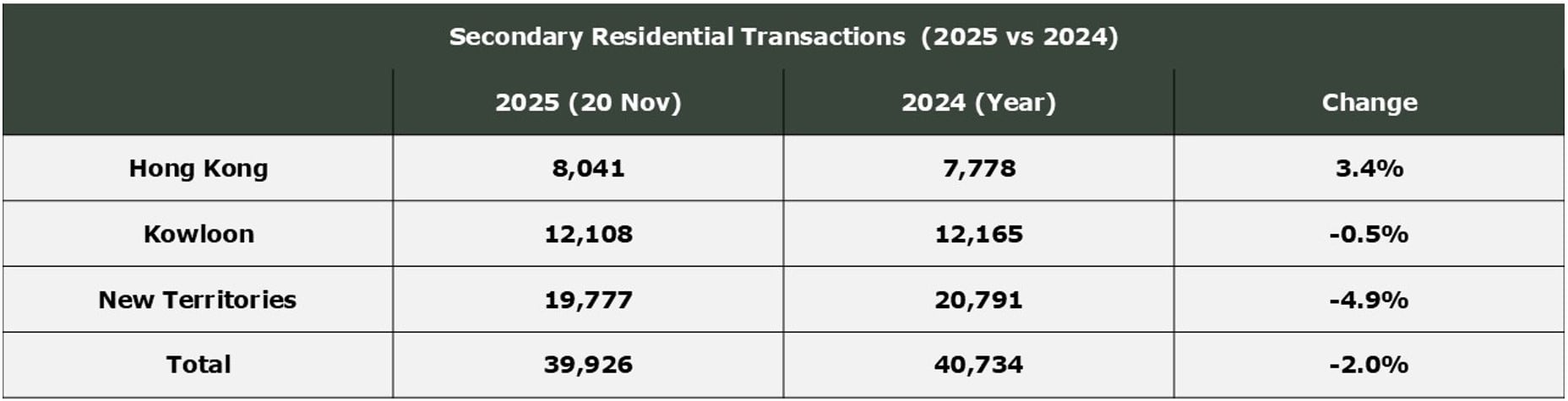
In the secondary market, transactions of 39,926 units have been copmleted, nearing the previous year's total of 40,734. Overall private residential transactions have increased by 1.2%, reaching 58,307, exceeding the previous year's total of 57,602.
The residential market is demonstrably in a turnaround phase, with developers exhibiting a clear shift in strategy. Abandoning the practice of "selling cheaply" or "selling at a loss," developers are now implementing price increases, reflecting the robust demand. This is exemplified by the successful launch of new developments at higher prices. For instance, the second phase of Cullinan Sky in Kai Tak saw a 30% price increase compared to the initial phase, yet still experienced strong demand, with initial units oversubscribed multiple times and selling out on the same day. This success is attributable to the project's prime location, the developer's reputation, and the precedent of strong secondary market performance for the initial phase. This trend underscores the market's resilience and the growing confidence among both developers and buyers.
The recent surge in activity is primarily attributable to a convergence of positive catalysts. These include the potential for interest rate adjustments, the easing of market cooling measures, the release of pent-up demand following the border reopening, and increased participation from mainland Chinese buyers. Furthermore, the sustained high cost of renting, with rental yields in certain areas exceeding 4%, has amplified the appeal of homeownership, as the "mortgage cheaper than rent" scenario becomes increasingly apparent. This dynamic is encouraging a shift from renting to buying, thereby accelerating the market's positive trajectory.
The primary market showcases remarkable strength. As of November 20, 2025, the market has seen transaction volume of 18,381 units, representing a substantial 9% increase compared to the entirety of the previous year's 16,868 transactions. This demonstrates a surge in consumer confidence and buying activity. The New Territories and Hong Kong Island have seen particularly strong growth, with 9,927 transactions in the New Territories, a 42.6% increase compared to last year's figures, and 3,205 transactions on Hong Kong Island, a 36.4% increase.
Source: Land Registry
In the secondary market, transactions of 39,926 units have been copmleted, nearing the previous year's total of 40,734. Overall private residential transactions have increased by 1.2%, reaching 58,307, exceeding the previous year's total of 57,602.
Source: Land Registry
The residential market is demonstrably in a turnaround phase, with developers exhibiting a clear shift in strategy. Abandoning the practice of "selling cheaply" or "selling at a loss," developers are now implementing price increases, reflecting the robust demand. This is exemplified by the successful launch of new developments at higher prices. For instance, the second phase of Cullinan Sky in Kai Tak saw a 30% price increase compared to the initial phase, yet still experienced strong demand, with initial units oversubscribed multiple times and selling out on the same day. This success is attributable to the project's prime location, the developer's reputation, and the precedent of strong secondary market performance for the initial phase. This trend underscores the market's resilience and the growing confidence among both developers and buyers.
The recent surge in activity is primarily attributable to a convergence of positive catalysts. These include the potential for interest rate adjustments, the easing of market cooling measures, the release of pent-up demand following the border reopening, and increased participation from mainland Chinese buyers. Furthermore, the sustained high cost of renting, with rental yields in certain areas exceeding 4%, has amplified the appeal of homeownership, as the "mortgage cheaper than rent" scenario becomes increasingly apparent. This dynamic is encouraging a shift from renting to buying, thereby accelerating the market's positive trajectory.