Valuer Insights
Business Insights | Hong Kong Luxury Property Faces Higher Stamp Duty Amid Market Boom
March 12, 2026

Contact
Angus Luk
Senior Director, Valuation & Advisory Services, Hong Kong

On February 25th, the Hong Kong government announced its annual budget, which included an adjustment to the stamp duty regime applicable to high-value residential transactions. Effective retroactively from February 26th, 2026, the stamp duty rate for residential properties valued at HK$100 million or above will increase from 4.25% up to 6.5%. This translates to a rise in stamp duty from HK$4.25 million to HK$6.5 million for a property priced at HK$100 million.
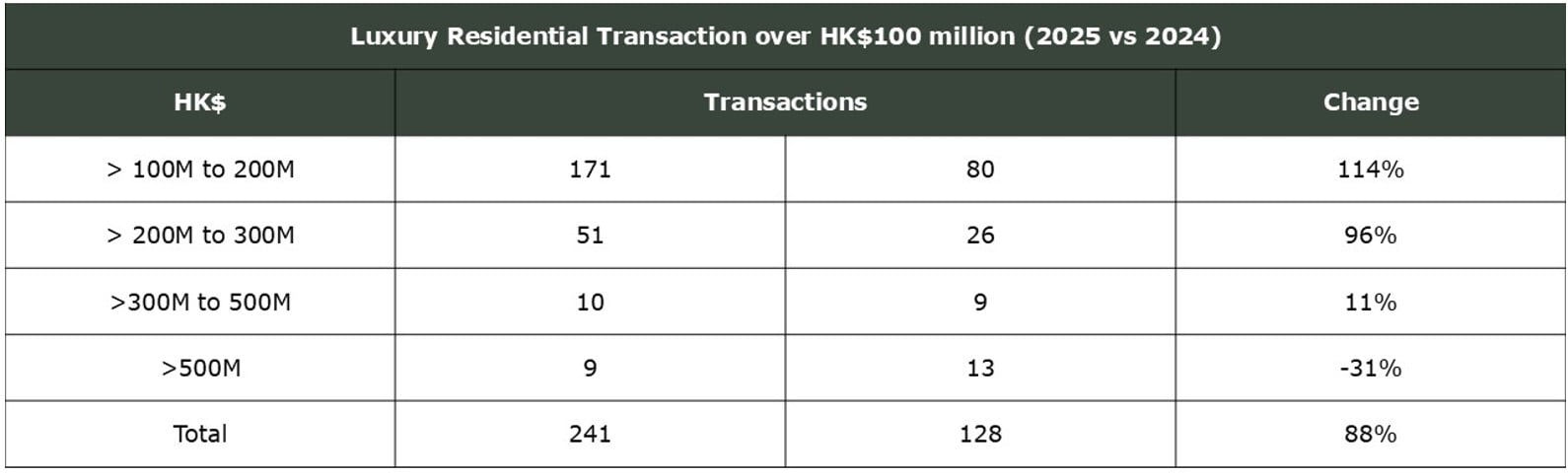
In 2025, according to data from the Land Registry, the luxury residential market demonstrated substantial growth. A total of 241 residential transactions exceeding HK$100 million were recorded, representing a significant increase of 88.3% compared to the 128 transactions recorded in 2024. For transactions of HK$100 million to HK$200 million, it posted an impressive surge of approximately 114% year-on-year, which is the new five-year high for this segment. The HK$200 million to HK$300 million segment also exhibited a strong momentum with 51 transactions recorded, indicating approximately 96% increase compared to the 26 transactions in 2024.
The supply of high-end residential properties remains limited. According to local agency data, a total of 26,107 secondary private flats are currently available for sale. Among these, 159 units are listed with asking prices exceeding HK$100 million.
Recent data from the Rating and Valuation Department (RVD) paint a picture of a revitalized residential market. The Residential Price Index for January reached 301.4 points, a 0.53% increase compared to the previous month. This marks the eighth consecutive month of growth, accumulating a total increase of 5.2%. This upward trajectory places the index at its highest point in over eighteen months and above the 300-point threshold for the first time since June 2024, when it registered 302.5 points. Furthermore, the adjusted full-year property price increase for 2025 was 3.7%. The cumulative decline from the September 2021 peak of 398.1 has also reduced to 24%. All of these point to a market that is steadily recovering.
While the revised 6.5% stamp duty for properties over HK$100 million increases costs, it remains substantially lower than the previous 8.5% Double Stamp Duty and 15% New Residential Stamp Duty, especially considering the prior 30% tax burden on mainland Chinese and corporate buyers. This represents an approximate 80% reduction in tax burden compared to the peak of cooling measures. In other words, the tax adjustment is only a minor tweak at a very low level.
Taking into account the supportive factors in the broader market, including the continued improvement in macroeconomic conditions, expectations of further rate cuts by the Federal Reserve, and steadily rising transaction volumes and buyer confidence, the overall upward trend in the residential sector is expected to continue. In summary, the new tax rate mainly affects ultra high value transactions, but its real impact on the overall housing market will be minimal (only around 0.3% of total transaction volume). In fact, it may even redirect some buyers toward small and medium sized units, contributing to a healthier market structure. While the previously expected 0–5% price increase for luxury homes may be revised to a more neutral outlook, the broader residential market is still poised for moderate growth through 2026.
Policy Boosts Government Revenue Amid Booming Luxury Property Market
This policy change comes at a time when the Hong Kong luxury residential market is experiencing a robust recovery, driven by a convergence of favourable factors. These include a sustained period of declining interest rates, positive performance in the equity markets, and the recent adjustments to the residential property price thresholds under the Investment as an Immigrant Scheme, all contributing to a significant influx of capital into the high-end property sector.In 2025, according to data from the Land Registry, the luxury residential market demonstrated substantial growth. A total of 241 residential transactions exceeding HK$100 million were recorded, representing a significant increase of 88.3% compared to the 128 transactions recorded in 2024. For transactions of HK$100 million to HK$200 million, it posted an impressive surge of approximately 114% year-on-year, which is the new five-year high for this segment. The HK$200 million to HK$300 million segment also exhibited a strong momentum with 51 transactions recorded, indicating approximately 96% increase compared to the 26 transactions in 2024.
Source: Land Registry
Mindful of Policy Impact
Market concerns about the timing and potential impact of the stamp duty adjustment. The increase in transaction costs could potentially weaken liquidity, dampen investment appetite and exert negative pressure on market sentiment.The supply of high-end residential properties remains limited. According to local agency data, a total of 26,107 secondary private flats are currently available for sale. Among these, 159 units are listed with asking prices exceeding HK$100 million.
Recent data from the Rating and Valuation Department (RVD) paint a picture of a revitalized residential market. The Residential Price Index for January reached 301.4 points, a 0.53% increase compared to the previous month. This marks the eighth consecutive month of growth, accumulating a total increase of 5.2%. This upward trajectory places the index at its highest point in over eighteen months and above the 300-point threshold for the first time since June 2024, when it registered 302.5 points. Furthermore, the adjusted full-year property price increase for 2025 was 3.7%. The cumulative decline from the September 2021 peak of 398.1 has also reduced to 24%. All of these point to a market that is steadily recovering.
While the revised 6.5% stamp duty for properties over HK$100 million increases costs, it remains substantially lower than the previous 8.5% Double Stamp Duty and 15% New Residential Stamp Duty, especially considering the prior 30% tax burden on mainland Chinese and corporate buyers. This represents an approximate 80% reduction in tax burden compared to the peak of cooling measures. In other words, the tax adjustment is only a minor tweak at a very low level.
Taking into account the supportive factors in the broader market, including the continued improvement in macroeconomic conditions, expectations of further rate cuts by the Federal Reserve, and steadily rising transaction volumes and buyer confidence, the overall upward trend in the residential sector is expected to continue. In summary, the new tax rate mainly affects ultra high value transactions, but its real impact on the overall housing market will be minimal (only around 0.3% of total transaction volume). In fact, it may even redirect some buyers toward small and medium sized units, contributing to a healthier market structure. While the previously expected 0–5% price increase for luxury homes may be revised to a more neutral outlook, the broader residential market is still poised for moderate growth through 2026.